
Checklist to ensure EU-funded measures contribute to independent living by developing and ensuring access to family-based and community-based services
|

Checklist to ensure EU-funded measures contribute to independent living by developing and ensuring access to family-based and community-based services

The purpose of the publication is to ensure EU funds contribute to independent living and inclusion in the community.

The checklist helps in designing policies and funding for:

  • Transition from institutional to family-based and community-based services for children, persons with disabilities, persons with mental health problems and elderly persons;
  • Development of quality family-based and community-based services;
  • Prevention of separation of children, including with disabilities, from their families.

The document can be a really useful tool for deciding about what kind of social care services are useful for inclusion, and what kind of service set-up is better avoided because it leads to segregation.
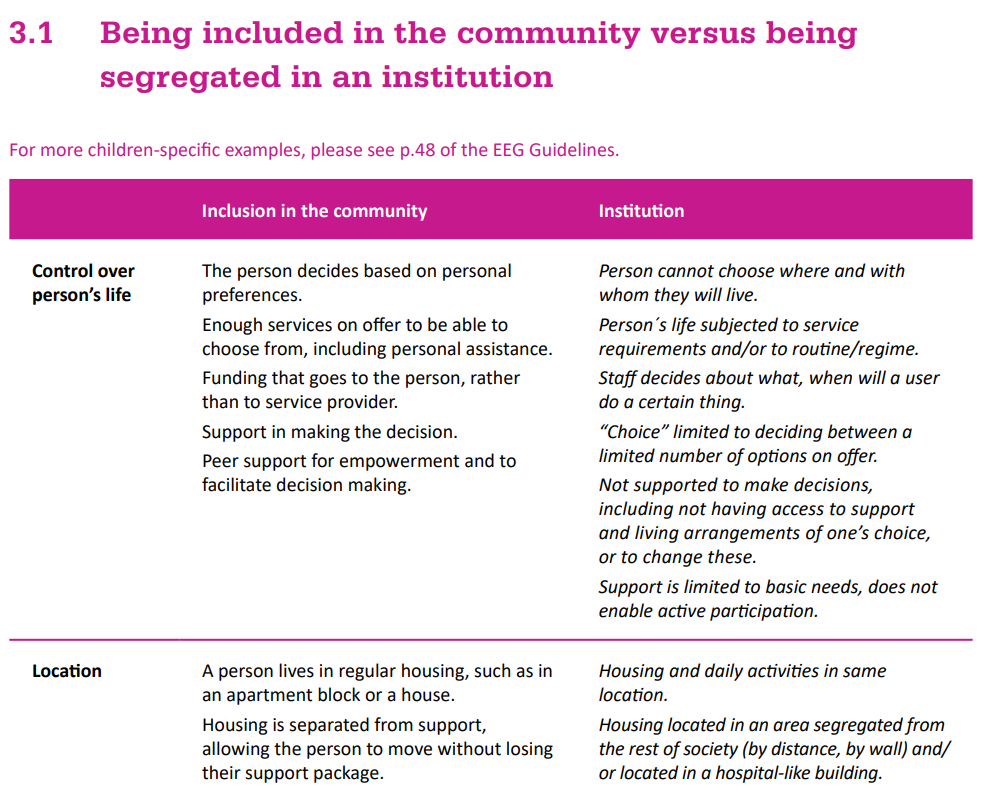
Being included in the community versus being segregated in an institution

Download it here.

I was leading the work on behalf of the EEG, alongside co-authors from Hope and Homes for Children.

Published in November 2019.
Similar Posts

  • |

    Guidance, report, judgement

    “Giving effect to independent living involves redirecting investments and resources from institutional settings and services to accessible and non-segregated places of residence, community-based services and support for persons with disabilities.” The European Commission released a Notice on “Guidance on independent living and inclusion in the community of persons with disabilities in the context of EU funding”. The Guidance…

  • | |

    DI is not a rocket science

    Global Disability Summite, Berlin, April 2025 As organisations of people with intellectual disabilities, and other advocates, we spend a lot of time demanding deinstitutionalisation.We also need to give time to working with those who make it happen. It’s about demonstrating to those responsible that deinstitutionalisation is doable.It has been done.It is being done.It can and…

  • |

    The Economics of Belonging

    Just notes and archives of some books I read and find interesting and relevant. “A radical new approach to economic policy that addresses the symptoms and causes of inequality in Western society today.” Absolute must-read for anyone interested in social policy (because that’s my angle). Haven’t read more relevant, coherent, current book on this subject….

  • |

    On fruits of labour

    Earlier this week I was in a workshop to learn, share, discuss disability rights and policies in the EU, with special attention to deinstitutionalisation. The message I brought was quite simple: Policies matter, and they have direct impact on people. It can take (scratch that – it takes) many years.It can be hard to see.(And…

  • | |

    Lack of action

    Lack of data (as important as it is) isn’t the main problem. Lack of action is. I was invited to speak at European Parliament’s Employment Committee workshop on independent living (and deinstitutionalisation) in December 2025. Didn’t say anything new I’m afraid. ❗️800,000+ people with intellectual disabilities in institutions❗️Many adults living with their families and relying…